
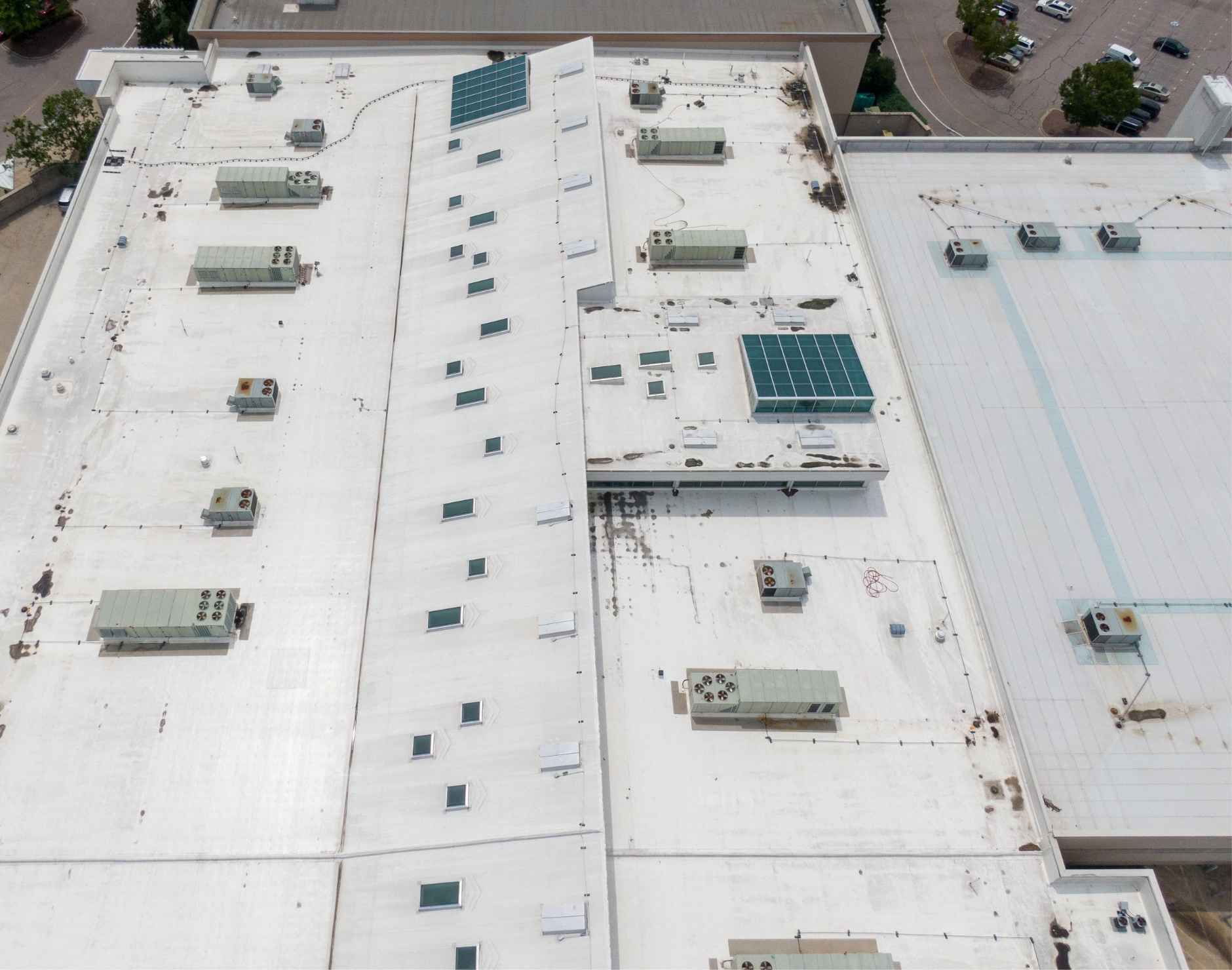
Flat roof manufacturers publish warranty terms of 20, 25, and 30 years. Those warranties are written under testing conditions that do not replicate South Florida's roofing environment. Palm Beach County's UV index, thermal cycling amplitude, annual rainfall intensity, and hurricane season mechanical stress interact with flat roofing membranes in ways that produce realistic service lives 25–35% shorter than national warranty claims suggest. A commercial or residential property owner in PBC who plans a 25-year capital replacement cycle based on a manufacturer's warranty is working from the wrong baseline. This guide provides honest flat roof lifespan expectations by system type for South Florida conditions, and explains the specific factors that extend or shorten service life within each system's realistic range.
The four South Florida factors that shorten flat roof lifespan
Four environmental conditions specific to South Florida interact to accelerate flat roof degradation at rates that national warranty testing does not capture. UV intensity is the primary factor — Palm Beach County's summer UV index of 10–11 breaks down the polymer matrix in TPO and EPDM membranes and the bitumen binder in modified bitumen systems at roughly double the rate of temperate climate testing. The photo-oxidation process that takes 25–30 years to produce meaningful membrane degradation in a northern climate produces equivalent degradation in 15–18 years on a South Florida flat roof exposed to direct sun.
Thermal cycling is the second factor. Daily roof surface temperature swings of 80–110°F — from overnight ambient lows to midday membrane surface temperatures approaching 180°F on dark membranes — stress every seam, flashing, and penetration detail through daily expansion-contraction cycles. Over hundreds of cycles per year, thermal fatigue accumulates at the stress concentration points that are also the most critical waterproofing details.
Rainfall intensity and volume is the third factor. PBC's 62 inches of annual rainfall — concentrated in the June–November wet season — subjects flat roof drainage systems to sustained high-volume water events that stress seams and flashings under hydrostatic pressure multiple times per month during the wet season. A seam that would hold indefinitely under occasional rainfall develops progressive separation under weekly hydrostatic loading cycles.
Hurricane season mechanical stress is the fourth factor. Six months of elevated wind exposure — not just named storm events but the sustained tropical wind activity that characterizes PBC's June–November season — produces cumulative fatigue at perimeter flashings, HVAC curb flashings, and membrane edge metal that is not present in non-hurricane markets. The cumulative wind stress of 20 hurricane seasons shortens the effective service life of every component in the roof assembly.
TPO lifespan in South Florida — 20 to 25 years
A properly installed 60-mil white TPO system on a PBC building with positive drainage, correct Product Approval attachment, and annual maintenance realistically delivers 20–25 years of service life before replacement is warranted. This is the closest alignment of any flat roofing system to its manufacturer warranty claims in South Florida conditions — TPO's heat-welded seams eliminate the primary thermal cycling failure mode (adhesive seam separation), and its white surface's 70–80% solar reflectance substantially reduces the UV and thermal degradation rate relative to dark membrane alternatives.
The limiting factor on TPO lifespan in PBC is membrane surface oxidation at the edges of heat-welded seams — the narrow strip of membrane surface immediately adjacent to the weld zone that is not covered by the lap and is subject to direct UV exposure. Over 15–18 years, this oxidation zone shows surface crazing and minor edge lifting that, if identified at annual roof inspection and addressed with seam edge sealer, can extend the system's service life by 3–5 years beyond what an uninspected system would achieve.
80-mil TPO extends the realistic South Florida service life to 22–28 years by providing greater membrane thickness at the seam edges and higher resistance to the thermal cycling fatigue that produces seam edge oxidation. The installed cost premium of 80-mil over 60-mil — typically $1.50–$3.00 per square foot — extends service life by 2–4 years, producing a favorable cost-per-year comparison on any building where the owner expects to hold the property for the full service period.
EPDM lifespan in South Florida — 15 to 22 years
Standard black EPDM realistically delivers 15–18 years of service life on a PBC flat roof before the combination of adhesive seam degradation, surface oxidation, and thermal cycling fatigue produces a system that is no longer economically maintainable. The surface temperature profile of black EPDM — reaching 180–200°F during PBC summer peak conditions — accelerates every degradation mechanism simultaneously.
White EPDM extends the realistic South Florida service life to 18–22 years by reducing surface temperatures to levels comparable to white TPO. The seam adhesive degradation mechanism remains — it cannot be eliminated by surface color — but at lower surface temperatures the adhesive degrades more slowly, and the maintenance interval between seam re-bonding treatments extends from 5–6 years to 7–9 years on a white EPDM installation with proper drainage.
EPDM's lifespan in PBC is highly maintenance-dependent in a way that TPO's is not. An EPDM system that receives regular seam re-bonding maintenance on schedule can achieve the upper end of its service life range. An EPDM system that goes 10–12 years without seam maintenance — common on properties where the original owner sold and the new owner was unaware of the maintenance requirement — will typically present with widespread seam separation and require full replacement before its theoretical service life is complete.
For flat roofing services in Palm Beach County including system condition assessments that estimate remaining useful life for any flat roof type, a licensed contractor can evaluate current membrane condition, seam integrity, and drainage performance to give you an honest remaining life estimate before a capital replacement decision is required. If the membrane still qualifies, coating instead of replacing extends the system 8 to 18 more years at a fraction of the cost.
Modified bitumen lifespan in South Florida — 18 to 25 years
Two-ply modified bitumen systems on PBC buildings realistically deliver 18–25 years of service life depending on cap sheet color, installation quality, and maintenance history. The multi-ply construction provides the redundancy that extends modified bitumen's service life beyond what single-ply systems achieve on high-traffic roofs — a failure in the top ply does not immediately produce water infiltration when a sound base ply is intact.
Granulated white or light gray cap sheet modified bitumen performs significantly better in South Florida conditions than dark-surfaced cap sheet. White granulated cap sheet reflects 55–70% of solar radiation — less than white TPO or EPDM but dramatically better than dark alternatives — and the granule surface provides physical protection against UV oxidation of the underlying bitumen matrix. Dark modified bitumen cap sheet in PBC's climate produces a surface temperature and degradation profile similar to black EPDM and should not be specified for new installations where energy performance and longevity are priorities.
What extends flat roof lifespan in PBC — the maintenance variables
Annual inspection by a licensed contractor is the highest-impact maintenance intervention for any flat roof system in South Florida. An annual roof inspection that identifies and repairs seam edge lifting, penetration flashing separation, drain blockage, and any membrane surface damage before these conditions progress through a wet season prevents the cascade from minor defect to water infiltration event that shortens system lifespan. The cost of an annual inspection — typically $500–$1,500 for a standard commercial flat roof in PBC — represents the highest-return maintenance investment available for any flat roofing system.
Drain clearing after every significant wind event and at wet season close is the second highest-impact maintenance practice. South Florida's organic debris accumulation on flat roofs is continuous — palm fronds, seed pods, leaves, and storm debris accumulate at drain baskets throughout the year and intensify during hurricane season wind events. A blocked drain that produces even minor ponding during the wet season imposes disproportionate hydrostatic stress on the membrane system relative to the low cost of clearing it. What ponding actually does to the assembly is detailed in the ponding water guide.
For a complete picture of what flat roof replacement costs when the current system reaches end of service life — including cost ranges by system type, size, and scope variables — see our 2026 flat roof replacement cost guide for Palm Beach County.
- Know your membrane type and installation date.** TPO, EPDM, and modified bitumen have different realistic service lives in South Florida. If unknown, a licensed contractor can identify the membrane type and approximate installation age from a condition inspection.
- Schedule annual inspections — every year, without exception.** Annual inspection is the single highest-return maintenance investment for any PBC flat roof. A $1,000 annual inspection prevents $50,000+ replacement events when it catches developing seam failures before they become water intrusion events.
- Clear drains after every significant wind event during hurricane season.** Organic debris accumulation during hurricane season is the most common cause of wet-season ponding on otherwise properly designed flat roofs in PBC.
- For EPDM systems over 8 years old, check seam adhesion annually.** Manually lift representative seam edges across field, edge, and corner zones. Seams that separate without resistance have failed adhesive bonds and reduced hydrostatic resistance. Schedule re-bonding before the next wet season.
- At 15 years, commission a condition assessment and remaining life estimate.** A written assessment at year 15 gives you 3–7 years of planning horizon for capital replacement budgeting — enough time to plan properly rather than react to a failure event.
- Prioritize drainage correction over membrane selection.** If your flat roof has ponding water, correcting the drainage design is more important to service life than which membrane system is installed above it.
- For roofs approaching end of service life, evaluate October–April replacement timing.** Replacing a flat roof outside hurricane season avoids the risk of a partially completed installation being exposed to a wet season storm event.


