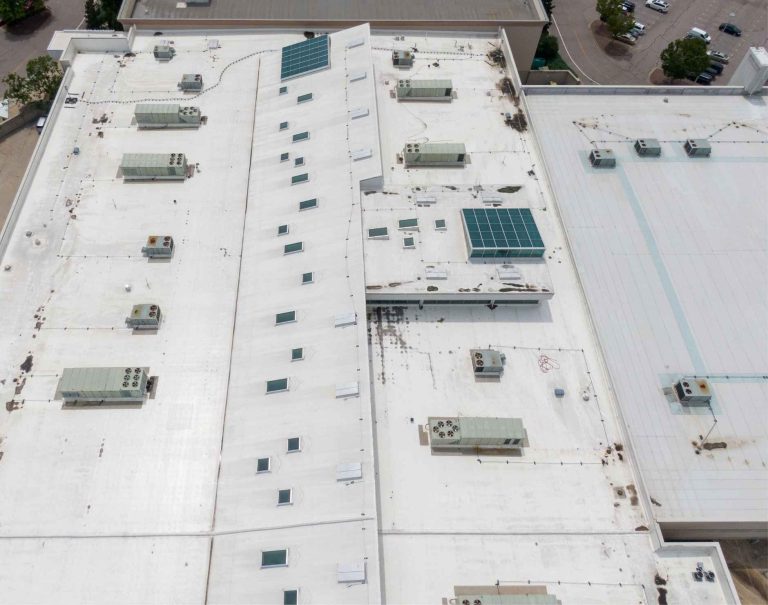
Flat roofing in Palm Beach County presents a different set of material decisions than pitched roofing — and the comparison between the three dominant flat roof systems requires evaluating performance in conditions that are specific to South Florida. Extreme UV, 62 inches of annual rainfall concentrated in a six-month wet season, daily thermal cycling between overnight lows and midday surface temperatures approaching 180°F, and annual hurricane season wind stress all interact with flat roofing membranes in ways that make the correct system selection for PBC meaningfully different from the correct selection in a temperate climate. This guide compares TPO, EPDM, and modified bitumen across the performance criteria that matter most in South Florida — seam integrity, drainage performance, wind uplift resistance, service life, and installed cost — so that PBC property owners can make the correct specification decision for their building.
TPO — the current standard for most PBC flat roof installations
Thermoplastic polyolefin (TPO) has become the dominant flat roofing specification for new installations and replacements on Palm Beach County residential and commercial buildings over the past decade. Its position as the default specification reflects a combination of performance advantages that are specifically relevant to South Florida's climate.
TPO's heat-welded seams are its defining performance advantage in PBC. The hot-air welding process fuses overlapping membrane panels at the molecular level, creating a seam that is stronger than the membrane itself when executed correctly. In South Florida's rainfall environment — where flat roofs receive intense, high-volume precipitation during the June–November wet season — a seam that cannot be infiltrated by water under hydrostatic pressure is the most important performance characteristic any flat roofing system can have. TPO's welded seams deliver this. EPDM's adhesive seams and modified bitumen's heat-fused or cold-applied laps do not provide equivalent seam integrity under the same conditions.
TPO's white surface reflects 70–80% of solar radiation, reducing roof surface temperatures by 50–80°F compared to dark-surfaced alternatives. In PBC's year-round sun environment, this thermal benefit reduces the rate of membrane degradation (lower surface temperatures mean slower UV oxidation of the polymer matrix) and meaningfully reduces the building's cooling load — an operational cost benefit that continues for the life of the installation.
TPO carries the broadest Florida Product Approval coverage for PBC's High Velocity Hurricane Zone of any flat roofing membrane. Most major manufacturers — Carlisle, GAF, Johns Manville, Firestone — maintain current HVHZ Product Approvals for their TPO systems in both mechanically attached and fully adhered configurations. Installed cost for 60-mil TPO on a standard PBC building runs $8–$16 per square foot depending on installation method, building complexity, and project scale.
EPDM — appropriate for specific PBC applications
Ethylene propylene diene monomer (EPDM) rubber membrane has been used in flat roofing since the 1960s and remains appropriate for specific applications in Palm Beach County — but it is no longer the default specification for most new flat roof installations, and understanding why requires understanding its specific performance weaknesses in South Florida's environment.
EPDM's primary weakness in PBC is seam adhesive performance. EPDM seams are bonded with contact cement or tape adhesive rather than heat-welded. Adhesive bonds in South Florida's thermal cycling environment — daily expansion and contraction cycles of 80–110°F at the membrane surface — degrade progressively over the installation's service life. Seam separation is the most common failure mode on aging EPDM roofs in PBC and is the source of the majority of leak events on older EPDM installations.
Standard black EPDM's solar absorption profile is also a significant disadvantage in South Florida. Roof surface temperatures on black EPDM can reach 180–200°F during summer peak conditions — temperatures that accelerate the rubber compound's degradation and impose substantial additional cooling load on the building. White EPDM addresses the thermal absorption issue but not the adhesive seam vulnerability.
EPDM's remaining appropriate applications in PBC are specific: re-roofing over existing sound EPDM systems where a full tear-off is not warranted; buildings with highly irregular roof geometry where EPDM's large-format sheet installation minimizes seam count below what TPO panel installation would produce; and owner preferences for rubber membrane construction where white EPDM is specified and the adhesive seam maintenance schedule is understood and budgeted. Installed cost for 60-mil white EPDM runs $7–$14 per square foot depending on installation method and project scale.
Modified bitumen — the multi-ply standard for demanding applications
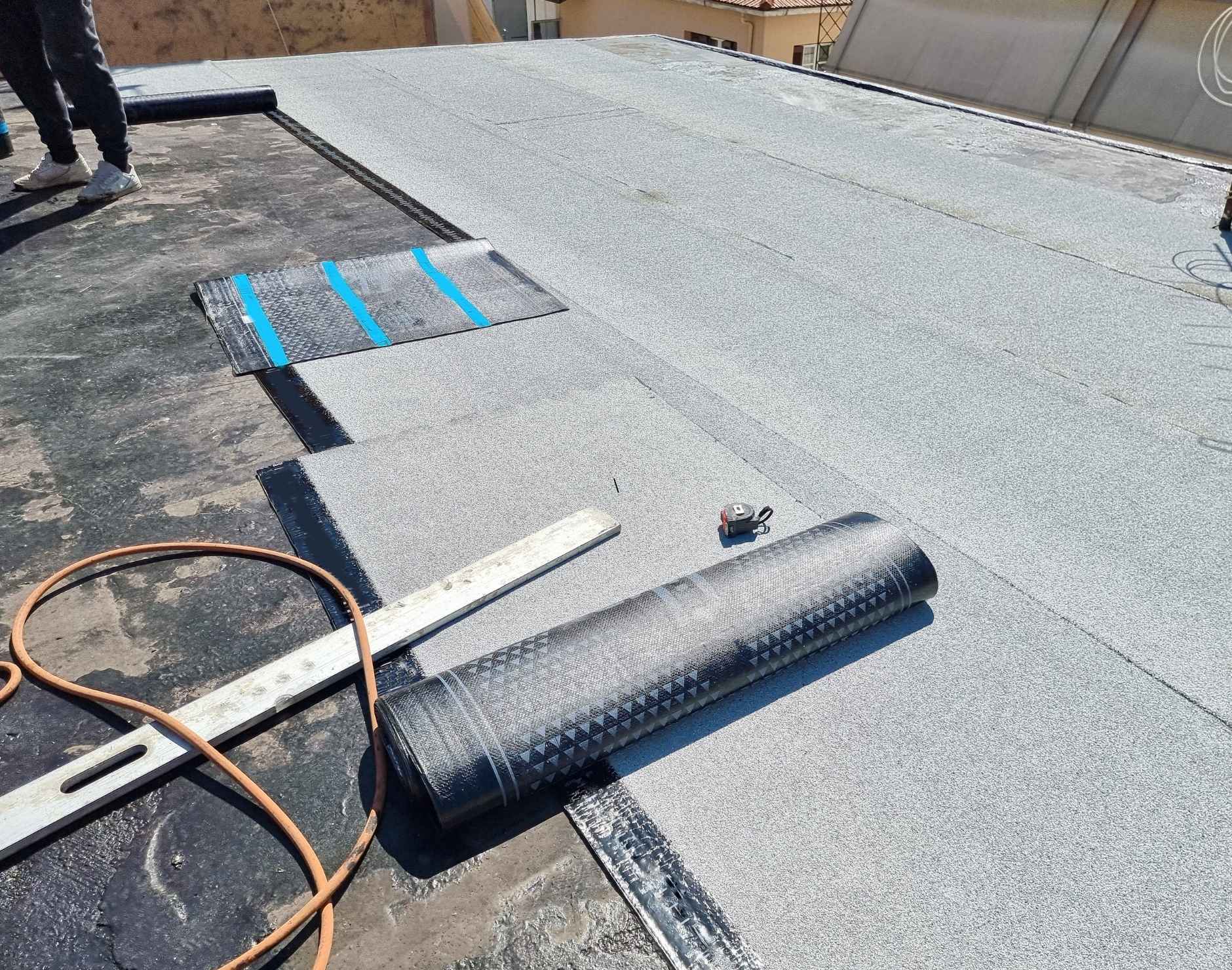
Modified bitumen (mod-bit) is an asphalt-based multi-ply membrane system that dominated commercial flat roofing in PBC through the 1990s and remains the appropriate specification for specific applications where single-ply membranes are not optimal. Two-ply and three-ply modified bitumen systems use SBS (styrene-butadiene-styrene) or APP (atactic polypropylene) modified asphalt membranes installed in multiple layers to create a redundant waterproofing assembly.
Modified bitumen's performance advantages in specific PBC applications are real. Its multi-ply construction provides inherent redundancy — a puncture or seam failure in the top ply does not immediately produce water infiltration if the base ply is intact. This makes mod-bit the preferred specification for roofs with significant foot traffic from maintenance personnel, rooftop mechanical servicing, or other use patterns that increase puncture risk. Modified bitumen also performs well on complex geometry — multiple roof levels, interior drains, heavy equipment platforms — where the torch-applied or cold-applied installation process can conform to irregular substrates better than single-ply sheet installation.
Modified bitumen's disadvantages in South Florida are primarily thermal and maintenance-related. Dark-surfaced mod-bit has the same solar absorption profile as black EPDM — high surface temperatures, accelerated aging, increased cooling load. Granulated cap sheet mod-bit in white or light gray reduces this disadvantage but does not eliminate it. The torch-applied installation process also introduces fire risk during installation that requires careful contractor management on occupied buildings.
Installed cost for two-ply modified bitumen replacement runs $9–$14 per square foot on standard PBC buildings. For flat roofing services in Palm Beach County covering all three membrane systems, the system selection for your specific building is based on the drainage geometry, use pattern, existing substrate condition, and Product Approval requirements for your HVHZ exposure zone. Drain sizing math for PBC rainfall is in the flat roof drainage guide.
Head-to-head comparison - the criteria that matter in South Florida
Seam integrity is the most important performance criterion for flat roofing in PBC's rainfall environment. TPO heat-welded seams are categorically superior to EPDM adhesive seams and modified bitumen laps under South Florida's combination of rainfall intensity and thermal cycling. A TPO seam that passes probe testing at installation will not separate due to thermal cycling or rainfall pressure. An EPDM adhesive seam will progressively weaken under the same conditions and requires periodic re-bonding maintenance to maintain integrity.
Solar reflectance determines the membrane's contribution to building cooling load and its own degradation rate. White TPO and white EPDM both reflect 70–80% of solar radiation. Granulated white cap sheet modified bitumen reflects 55–70%. Standard black EPDM and dark modified bitumen absorb 85–90% of solar radiation and are not appropriate specifications for most South Florida flat roof applications where energy performance matters.
Wind uplift performance depends on the specific system Product Approval rather than the membrane type alone. TPO, EPDM, and modified bitumen all have Product Approvals available for PBC's HVHZ — the correct approval depends on membrane thickness, installation method, and attachment pattern. For any flat roofing system in PBC's HVHZ, the Product Approval documentation is required for permit application and must be provided by the contractor before installation begins.
Service life in South Florida conditions for properly installed systems runs 20–25 years for 60-mil TPO, 15–22 years for EPDM (shorter for black, longer for white with maintenance), and 18–25 years for two-ply modified bitumen. All three systems require annual inspections and prompt repair of any identified defects to achieve the upper end of their service life ranges in PBC's demanding climate. Full aging benchmarks are in the flat roof lifespan guide.
Making the correct system selection for your PBC property
For most PBC residential and commercial flat roof replacements in 2026, 60-mil white TPO is the correct default specification. Verified flat roofing contractors in West Palm Beach and across PBC install all three systems. It delivers the strongest seam integrity, best solar reflectance, broadest Product Approval coverage, and lowest long-term maintenance cost of the three systems for South Florida's specific conditions.
EPDM in white is appropriate where TPO is not available with the required Product Approval for a specific application, where the owner has an established EPDM maintenance program and prefers to continue with the same membrane family, or where the building geometry makes EPDM's large-format installation method advantageous.
Modified bitumen is appropriate for high-traffic roofs, roofs with complex geometry where multi-ply installation provides better waterproofing redundancy, and re-roofing applications over existing mod-bit systems where a recover specification is the most economical approach. For properties where waterproofing extends beyond the roof membrane to below-grade walls, planter decks, or balcony surfaces, see our waterproofing services for Palm Beach County — these applications require specialized coating and membrane systems beyond standard flat roofing products.
- Default to 60-mil white TPO for most new flat roof installations and replacements in PBC.** Heat-welded seams, high solar reflectance, and broad HVHZ Product Approval coverage make TPO the correct default for South Florida conditions in 2026.
- Confirm the proposal includes a tapered insulation system for positive drainage.** A flat roof without positive drainage to all drain and scupper locations violates FBC and accelerates membrane degradation regardless of membrane type.
- For EPDM proposals, specify white membrane and confirm the seam adhesive maintenance schedule.** Black EPDM is not appropriate for most PBC applications. White EPDM requires periodic re-adhesion maintenance — budget for it explicitly.
- For modified bitumen proposals, confirm the cap sheet color and surface treatment.** Dark-surfaced mod-bit has the same thermal disadvantages as black EPDM in South Florida. Specify granulated white or light gray cap sheet for any PBC mod-bit installation.
- Request the Florida Product Approval number for the proposed system.** All three membrane systems have HVHZ Product Approvals available — confirm the specific approval covers your building's design wind speed zone before installation begins.
- Confirm annual inspection is included in the post-installation service plan.** All three systems require annual inspections to maintain warranty coverage and achieve realistic South Florida service life. Budget for this from day one.
- For applications beyond the roof membrane — below-grade walls, balconies, planter decks — confirm the contractor has waterproofing-specific experience and products.** Standard flat roofing membranes are not the correct specification for all waterproofing applications.