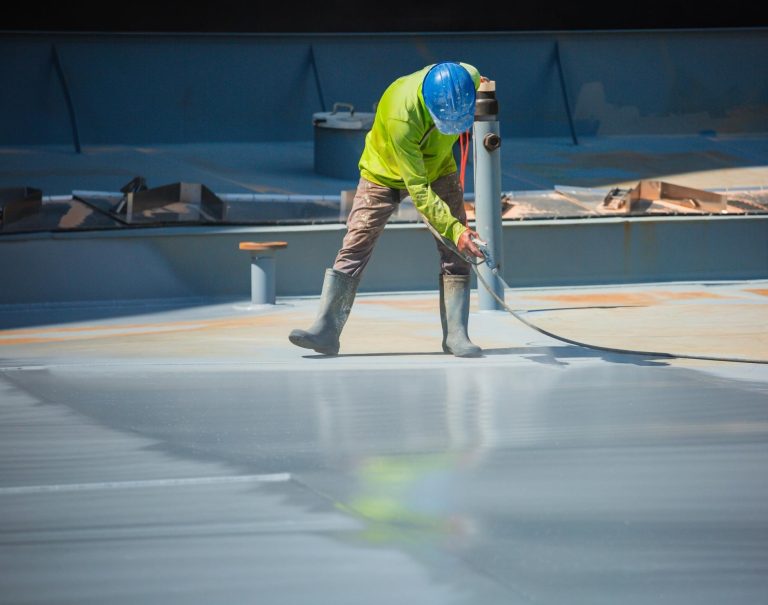
Coating over an existing flat roof is not always appropriate — and applying a coating to a roof that should be replaced is one of the most expensive mistakes a PBC property owner can make. The coating cost is paid, the underlying problems are masked rather than resolved, and within 2–5 years the active failures beneath the coating produce water intrusion that now requires both the deferred replacement and remediation of the interior damage that the coating delayed but did not prevent. The decision to coat vs. replace an existing PBC flat roof is a technical assessment, not a cost preference — and it turns on four specific criteria that must all be satisfied before coating is the appropriate scope. This guide explains those criteria and how to verify each one before approving any coating proposal.
Criterion 1 — The existing membrane must be structurally sound
A coating is a protective and waterproofing layer applied over an existing membrane — it does not add structural integrity to a membrane that has lost it. For a PBC flat roof membrane to be a coating candidate, the existing membrane must be physically intact: no widespread surface cracking or crazing that has penetrated to the reinforcing scrim, no areas where the membrane has torn or been punctured and not repaired, and no sections where the membrane has fully separated from the substrate and is floating or tent-seaming.
Surface oxidation and surface chalking — the normal weathering of an aging TPO or elastomeric membrane in South Florida — does not disqualify a membrane from coating candidacy. A membrane can show significant surface weathering and still be structurally sound beneath the weathered surface layer. The assessment question is whether the membrane's structural integrity — its ability to bridge minor substrate irregularities and resist membrane-level mechanical stress — is intact. An experienced licensed contractor can make this assessment visually and through physical manipulation of representative membrane sections during the pre-coating inspection.
Criterion 2 — Seams must be intact and adhered
Seam integrity is the most critical candidacy criterion for coating application because a coating bridges seam surfaces but does not weld or re-bond separated seam interfaces. A coating applied over a separated seam produces a cosmetically smooth surface over an active water infiltration path — the coating will eventually split at the seam location as the underlying separation cycles with thermal expansion, and the seam will leak.
Before any coating application, every seam on the existing membrane must be physically tested — not visually inspected from ground level. A licensed contractor tests seam integrity by manually attempting to lift representative seam edges across field, edge, and corner zones. Seams that separate with manual pressure are not coating candidates at those locations — they require re-welding (TPO) or re-bonding (EPDM, modified bitumen) before coating. If the percentage of failed seams is greater than 15–20% of total seam length, the scope has shifted from coating with seam repair preparation to membrane replacement — the labor and material cost of re-bonding 20% of a large roof's seam network approaches the cost of a new membrane, without the warranty and service life benefits of replacement.
On TPO membranes, failed seams can be re-welded with a hot-air welder if the membrane material is in adequate condition for welding. On EPDM and modified bitumen, adhesive re-bonding or tape seam overlay is the repair approach. Both require the seam surfaces to be clean, dry, and free of biological contamination before repair — which means seam repair on PBC flat roofs always follows pressure washing, not precedes it.
Criterion 3 — Subsurface moisture must be below 20% of roof area
Subsurface moisture — water saturating the insulation layer beneath the existing membrane — disqualifies a roof from coating candidacy at the affected locations. Coating over saturated insulation traps the moisture in the assembly, where it continues to degrade the insulation's thermal performance and the membrane's adhesion from below. Over one to two wet seasons, trapped subsurface moisture produces additional membrane delamination, biological growth in the assembly, and structural deck moisture that compounds the original problem.
The threshold for coating candidacy is subsurface moisture saturation below 20% of total roof area. This threshold can only be verified by a moisture scan — infrared thermography conducted after sunset when the roof surface is cooling (wet insulation retains heat longer than dry insulation, producing thermal contrast visible to an infrared camera) or nuclear moisture meter testing. Visual inspection of the membrane surface does not reveal subsurface moisture — a membrane that appears dry and intact at the surface can have extensive subsurface saturation invisible from above.
Areas of subsurface moisture saturation identified by scan must be cut out, dried, and replaced with new dry insulation before coating is applied. If the saturated area is less than 20% of total roof area, repair of the saturated zones followed by coating of the full roof is economically justified. Above 20% saturation, full replacement is typically more cost-effective than the combination of extensive insulation replacement and coating application. Side-by-side project budgets are in the roof coating cost guide.
For waterproofing services in Palm Beach County including pre-coating assessments with moisture scan, seam testing, and condition reports, a licensed contractor provides the technical basis for the coating vs. replacement decision before any scope is approved. Verified roofers in Riviera Beach and across PBC perform these candidacy assessments.
Criterion 4 — Drainage must be adequate or correctable
As covered in our coating comparison guide, elastomeric acrylic coating is not appropriate on any PBC flat roof with ponding water conditions. Before coating is applied, drainage adequacy must be confirmed — either by demonstrating that the existing roof drains positively to all outlets within 48 hours of any rainfall event, or by correcting the drainage deficiency as part of the pre-coating scope.
Drainage correction before coating — clearing blocked drains, installing supplementary scuppers, or adding tapered insulation overlays at low points — adds scope and cost to the project. But this scope is necessary: coating over an inadequately draining roof with elastomeric coating produces premature failure at ponding zones that voids the coating's cost-effectiveness argument. If silicone coating is specified, the ponding water degradation mechanism is eliminated — but ponding water still accelerates underlying membrane degradation and should be corrected regardless of coating type.
The FBC 25% cumulative repair rule and coating applications
Florida Building Code Section 706 establishes that cumulative roof repairs exceeding 25% of total roof area require full replacement rather than additional partial repair. Roof coating applications are a modification to the roof assembly — and the seam repairs, insulation replacement, and flashing work that precede coating application contribute to the cumulative repair calculation. A PBC property owner whose roof has undergone multiple repair events over the years should ask a licensed contractor to calculate cumulative repair coverage before approving a coating project that may push the total above the 25% replacement threshold.
This is not a reason to avoid coating on an otherwise suitable roof — it is a reason to verify the cumulative repair status before the coating project begins. A contractor who performs seam repairs, insulation replacement, and flashing work prior to coating without calculating the cumulative threshold may inadvertently trigger the replacement requirement, creating a compliance situation that is more disruptive to address after the coating is already applied than before it began.
What makes a roof unsuitable for coating — the disqualifying conditions
Four conditions disqualify a PBC flat roof from coating candidacy regardless of other factors: active leak sources that have not been identified and repaired at their source; subsurface moisture saturation above 20% of total roof area; widespread seam separation affecting more than 15–20% of total seam length; and structural deck damage that requires substrate replacement before any new surface system is installed. When any of these conditions is present, coating defers rather than resolves the problem and full membrane replacement is the appropriate scope.
For a complete overview of flat roofing replacement options available for PBC buildings — including TPO, EPDM, and modified bitumen system specifications — when the coating candidacy assessment determines that replacement is the correct scope, see our flat roofing services page.
- Commission a moisture scan before approving any coating proposal.** Infrared or nuclear moisture scanning is the only reliable method for detecting subsurface saturation invisible from the surface. No coating proposal should be approved without it.
- Require physical seam testing — not visual inspection.** A licensed contractor must manually lift representative seam edges across field, edge, and corner zones. Visual inspection from ground level does not assess seam integrity.
- If failed seams exceed 15–20% of total seam length, reassess whether replacement is more cost-effective.** The labor cost of re-bonding extensive failed seams approaches replacement cost without the warranty and service life benefits of a new membrane.
- Confirm drainage adequacy or require drainage correction as part of the pre-coating scope.** Coating over an inadequately draining roof with elastomeric coating is a premature failure waiting to happen at ponding zones.
- Ask your contractor to calculate cumulative repair coverage before approving the scope.** Seam repairs and insulation replacement preceding coating application contribute to FBC Section 706's 25% cumulative threshold.
- Do not approve coating over any active leak source.** The source must be identified and repaired before coating application. Coating bridges surface imperfections but does not seal active water infiltration paths.
- If any of the four disqualifying conditions are present, proceed to replacement.** Active leaks, subsurface saturation above 20%, widespread seam failure, or structural deck damage all require replacement — coating defers but does not resolve these conditions.