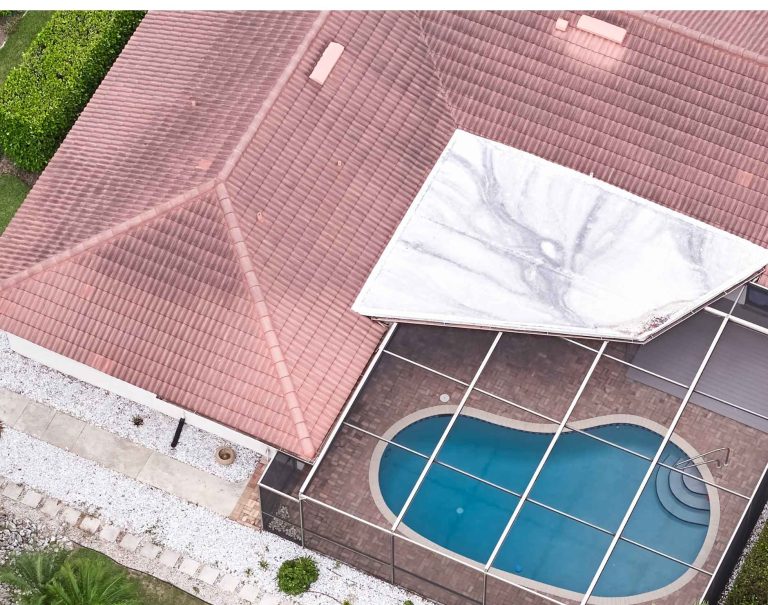
Yes — existing tile can be reused in a Florida roof replacement, and in many Palm Beach County scenarios, it is the most cost-effective approach. The standard tile salvage scope removes existing tile carefully, replaces the underlayment and secondary water barrier to current Florida Building Code specifications, and reinstalls structurally sound tile. The result is a FBC-compliant installation with new underlayment life and Citizens Insurance wind mitigation eligibility — at 15–25% lower cost than a full system replacement with new tile. The decision to salvage or replace tile is not a contractor preference — it is an engineering question with specific criteria.
When tile reuse is appropriate
Tile reuse is appropriate when four conditions are met. Each condition is assessable by a licensed CCC contractor during a pre-replacement inspection.
Condition 1 — Structural tile integrity. The existing tile must be structurally sound — no hairline cracks from thermal cycling, no soft sections that indicate hidden internal fracture, no spalling or surface disintegration. A tile that appears intact from the exterior may have internal micro-cracks that produce full breaks when removed and reinstalled. A licensed CCC contractor performing a pre-salvage assessment taps tiles systematically with a hard mallet — a dull or hollow sound indicates internal fracture that the exterior surface does not show. Tiles that fail the tap test are candidates for replacement, not salvage.
Condition 2 — Acceptable breakage percentage. Even a well-maintained PBC tile roof will have some percentage of cracked or broken tiles from prior wind events, hail, foot traffic, or thermal cycling. Tile salvage is cost-effective when the percentage of damaged tile requiring replacement does not exceed approximately 15% of total tile count. Beyond 15% damaged tile, the cost of sourcing matching replacement tile, the extended lead times for discontinued profiles, and the labor of sorting and staging the damaged tile in the field begins to approach the cost of specifying all-new tile. The contractor's pre-salvage assessment establishes the damaged tile percentage before the contract is signed.
Condition 3 — Profile availability for replacement tiles. The salvage scope requires replacement tile for damaged sections. That replacement tile must match the existing profile — or the visible mismatch will be apparent across the entire roof surface. Confirm that matching tile in the existing profile is currently available before authorizing any salvage scope. Discontinued profiles that require custom orders add 3–8 weeks to the project timeline and $200–$600 per square in material premium.
Condition 4 — The underlayment is the limiting factor, not the tile. Tile salvage is the correct scope when the underlayment has reached end of service life but the tile above it has substantial remaining life. If the tile itself is near end of life — widespread granule loss on concrete surfaces, widespread surface spalling, thermal cycling damage across the majority of tiles — full replacement with new tile is the appropriate scope regardless of underlayment condition. The full three-variable decision framework is in tile repair vs. replacement for PBC homes.
The tile salvage process — what it actually involves
Tile salvage is more labor-intensive than a straight tear-off, which is reflected in the cost structure. The process includes:
Staged removal — tile is removed by hand, working from the ridge down, and staged on the roof surface or lowered to ground staging areas rather than thrown into a skip as in a full tear-off. Each tile is handled twice rather than once, and the handling must be careful enough to avoid breaking sound tile during the removal process.
Tile inspection and sorting — removed tile is inspected (tap test and visual) and sorted into sound tile for reinstallation, damaged tile for replacement, and tile that is marginal but may be used in less-visible locations. This sorting step adds labor time that does not exist in a full replacement scope.
Underlayment and secondary water barrier installation — identical to a full replacement scope. The deck is cleaned, inspected for any decking damage, and new underlayment and secondary water barrier are installed to current FBC Chapter 15 specifications.
Tile reinstallation — sound tile is reinstalled following the attachment method specified in the tile's Florida Product Approval document. Damaged tile sections are filled with matching new or salvage tile. The attachment must meet current FBC Chapter 15 specifications — not the original installation specifications if those predate current code requirements.
For tile roofing services in Palm Beach County including tile salvage underlayment replacement, a licensed CCC contractor provides a written scope with a salvage tile count, damaged tile percentage, and total cost prior to contract signing — not as a post-tearoff adjustment.
Cost comparison — tile salvage vs. full replacement
Tile salvage with underlayment replacement typically costs 75–85% of a full system replacement with new tile of equivalent profile. The savings reflect the elimination of new tile material cost offset by the additional labor of staged removal, sorting, and careful reinstallation.
On a concrete tile system where full replacement with new tile would cost $50,000, tile salvage with new underlayment typically runs $37,500–$42,500. The $7,500–$12,500 savings represents the net benefit after accounting for the additional labor cost relative to tear-off.
The savings are larger on clay tile systems where the material cost differential between new and salvaged tile is greater. On a clay tile system where full replacement would cost $80,000, tile salvage with new underlayment can run $56,000–$68,000 — a $12,000–$24,000 savings that reflects the high material cost of new clay tile relative to the labor cost of salvaging sound existing tile.
The savings decrease — and may disappear entirely — when the damaged tile percentage is high, when matching replacement tile must be sourced at a premium for a discontinued profile, or when the existing tile requires extensive sorting and staging due to prior improper storage or repair work.
Citizens Insurance and tile salvage
A tile salvage underlayment replacement that is performed to current FBC specifications, permitted, and passes final inspection produces the same Citizens Insurance outcomes as a full replacement: new wind mitigation inspection eligibility, new remaining life clock based on the new underlayment, and full wind mitigation credit eligibility based on the documented construction features.
Citizens Insurance does not distinguish between a new tile installation and a salvaged tile reinstallation in its wind mitigation credit calculation — the credits are based on the construction features documented on OIR-B1-1802, not on whether the tile is new or salvaged. A properly documented tile salvage installation with secondary water barrier, compliant attachment, and permitted final inspection generates the same OIR-B1-1802 results as an equivalent new tile installation. Verified roofers serving Gulf Stream and PBC's tile-heavy communities quote salvage and full replacement side by side.
For a complete breakdown of what tile replacement and salvage costs in Palm Beach County in 2026, including full replacement vs. salvage cost comparison by material, see our dedicated tile cost guide.
- Ask your contractor to perform a tap test assessment on representative tiles before signing any salvage contract.** The tap test identifies internal fractures that exterior inspection misses. Tiles that fail the tap test are replacement candidates — not salvage candidates.
- Ask for the damaged tile percentage estimate before signing.** If more than 15% of tiles require replacement, evaluate whether full replacement with new tile may be more cost-effective than salvage with expensive matching-tile sourcing.
- Confirm matching tile availability for the damaged sections.** If the existing profile is discontinued, confirm lead time and cost premium for replacement tile before committing to the salvage scope.
- Confirm the reinstallation will follow the current Florida Product Approval attachment specification.** Salvage does not exempt the installation from current FBC Chapter 15 requirements. The attachment method must match the current Product Approval — which may differ from the original installation method.
- Confirm the salvage scope includes secondary water barrier.** FBC requires secondary water barrier on all new tile installations in PBC — including tile salvage underlayment replacement events. Its inclusion is non-negotiable for FBC compliance and Citizens Insurance wind mitigation eligibility.
- After completion, schedule a wind mitigation inspection.** A tile salvage installation with compliant attachment and secondary water barrier generates the same OIR-B1-1802 wind mitigation credits as a full new tile installation. File the report with Citizens Insurance promptly.