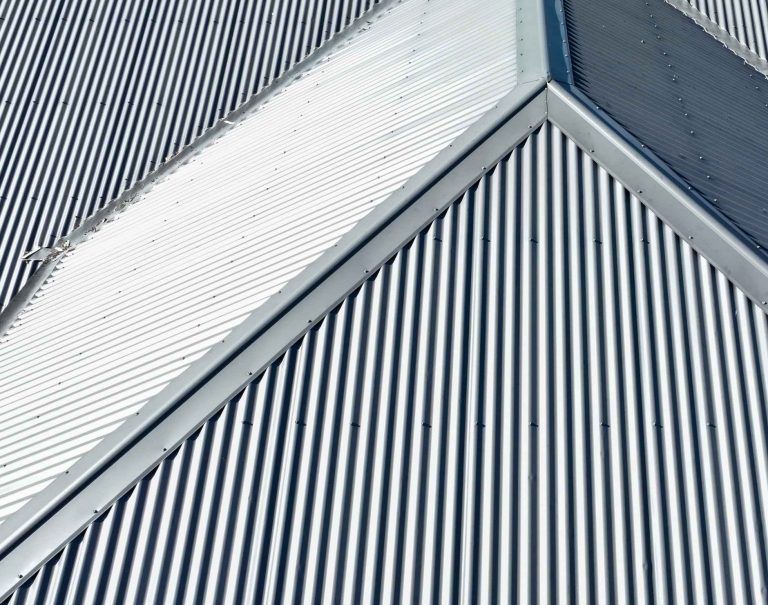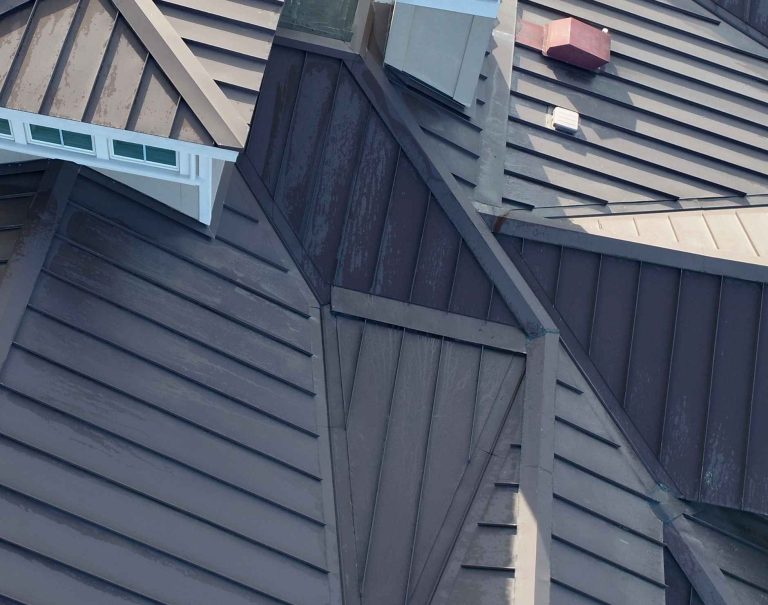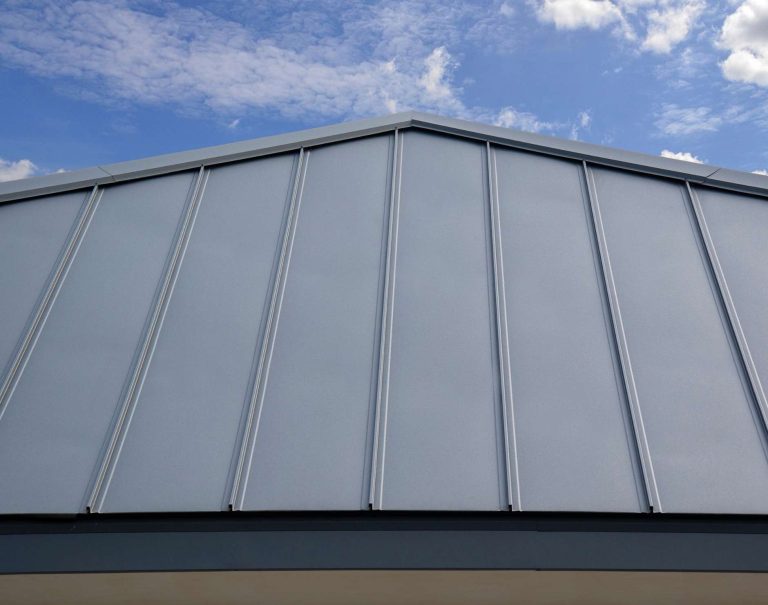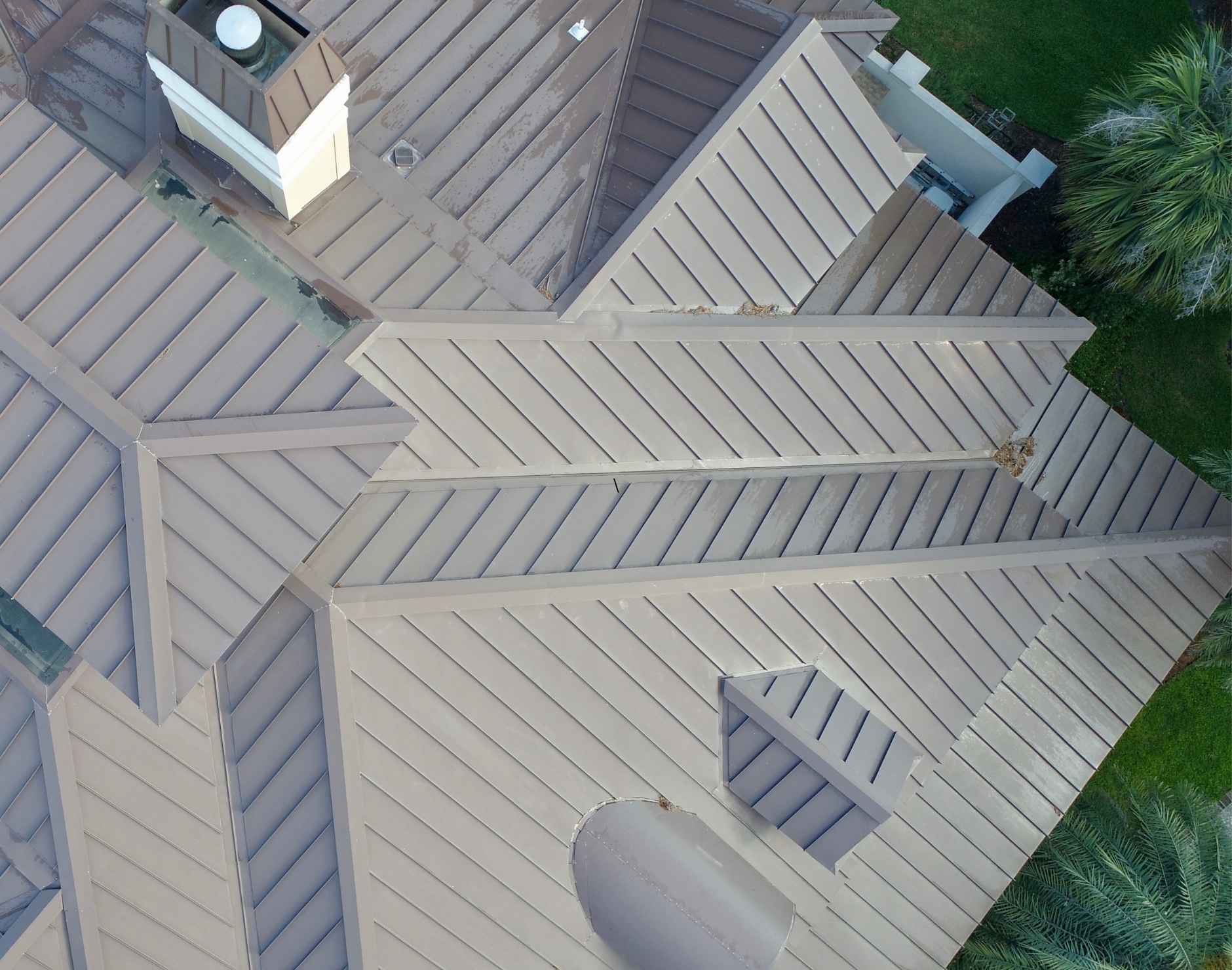
The Galvalume vs. aluminum decision is the most location-specific choice for metal roofing in Palm Beach County — and the one most frequently made incorrectly by contractors who don't distinguish between PBC's coastal and inland market environments. The consequences of the wrong choice are not visible at installation. They appear 5–10 years later as panel surface corrosion, rust staining on exterior walls, and fastener failure at the coastal property that received Galvalume when aluminum was required. This guide provides the objective criteria for making the correct material decision based on property location, and explains what happens when each material is used outside its appropriate application zone.
What Galvalume is and why it works inland
Galvalume is a steel substrate coated with a zinc-aluminum alloy — typically 55% aluminum, 43.4% zinc, and 1.6% silicon by mass. The zinc-aluminum alloy coating provides corrosion protection through two mechanisms: barrier protection (the coating physically separates the steel substrate from the environment) and galvanic protection (zinc sacrificially corrodes to protect the steel at any point where the coating is compromised — cut edges, scratches, fastener holes).
In non-coastal environments — properties more than approximately one mile from open saltwater — Galvalume's zinc-aluminum coating provides excellent corrosion resistance. The zinc's sacrificial protection at vulnerable points means that even a scratched Galvalume panel continues to resist corrosion in a non-coastal environment because the surrounding intact coating galvanically protects the exposed area.
Galvalume steel is the standard material for metal roofing in inland PBC — Wellington, Royal Palm Beach, Palm Beach Gardens inland, Westlake, Greenacres, Boynton Beach inland, and similar communities where the corrosive conditions present at the waterline are not a factor. It delivers 40–60 years of realistic service life at 20–30% lower material cost than aluminum.
What aluminum is and why it is required at the coast
Aluminum is a non-ferrous metal that does not rust or corrode in salt-air environments. Unlike Galvalume — where the steel substrate is protected by a zinc-aluminum alloy coating — aluminum panels are corrosion-resistant throughout their full cross-section. There is no steel substrate to protect, no coating system to maintain, and no galvanic corrosion mechanism when the surface is scratched or the panel is cut.
At PBC's coastal properties — barrier islands, oceanfront, Intracoastal-adjacent, and any property within approximately one mile of the waterline — the chloride ions present in salt air attack the zinc portion of Galvalume's protective coating at an accelerated rate. Once the zinc is depleted at any location, the underlying steel substrate is exposed to the same chloride-rich environment, and corrosion propagates rapidly. Cut edges, fastener holes, and any surface scratches are the initiation points — and in a coastal environment, they can progress from surface rust to structural failure within 5–15 years of installation.
Aluminum does not experience this failure mode. Its corrosion resistance in coastal environments is not coating-dependent — it is an inherent property of the base metal. A properly installed aluminum standing seam or metal tile installation within PBC's coastal salt-air zone will not show corrosion at cut edges, fastener points, or surface scratches, and will deliver its full 50+ year service life. Complete service-life ranges by substrate are in the metal roof lifespan guide.
The one-mile rule — where does coastal become inland?
The transition from coastal to inland specification is not a bright line at exactly one mile — it is a gradient influenced by property elevation, prevailing wind direction, proximity to any open body of saltwater (ocean, Intracoastal, large bays), and the degree of vegetative buffer between the property and the water.
The practical guidance for PBC: any property with direct ocean or Intracoastal frontage requires aluminum specification. Any property within one mile of the ocean or a major Intracoastal waterway in an unobstructed coastal corridor should use aluminum specification. Properties one to two miles from the waterline in areas with moderate vegetative buffer and intervening development may be appropriate for Galvalume, but the decision should be made by a licensed CCC contractor who knows the local corrosion conditions rather than by a map measurement alone.
Properties more than two miles from any open saltwater body in PBC's inland areas — most of Wellington, Royal Palm Beach, Greenacres, western Boynton Beach, and similar communities — are clearly in Galvalume territory. The cost savings of Galvalume over aluminum in these locations produce no performance penalty.
For metal roofing services in Palm Beach County from a licensed CCC contractor familiar with local corrosion conditions, material specification advice based on property location is part of the pre-proposal assessment — not a decision left to the homeowner.
The cost difference between Galvalume and aluminum
Aluminum costs 20–30% more than Galvalume steel for equivalent panel profiles and gauges. On a 2,400 square foot roof surface, the material cost difference between Galvalume and aluminum specification represents approximately $4,000–$10,000 in additional installed cost depending on the profile and gauge selected. Full per-profile pricing is in the metal roof cost guide for Palm Beach County.
For a coastal property that requires aluminum, this premium is the correct investment — it prevents the much larger cost of premature system failure and replacement within 5–15 years of a Galvalume installation. For an inland property where Galvalume is the appropriate specification, the aluminum premium produces no performance benefit and represents unnecessary cost.
The decision is binary: the correct material for the location. There is no middle option — a "coastal Galvalume with extra coating" specification does not perform equivalently to aluminum in the salt-air zone. Zinc-aluminum alloy coating, regardless of thickness, is depleted by coastal chloride exposure in a way that aluminum's inherent corrosion resistance is not.
Galvanic corrosion — the hidden risk in any metal roofing installation
Galvanic corrosion occurs when two dissimilar metals are in electrical contact in the presence of an electrolyte — in PBC's context, the electrolyte is rain water or humid salt air. The less noble metal (the anode) corrodes preferentially to protect the more noble metal (the cathode). In a roofing context, the most common galvanic corrosion scenarios are:
Aluminum panels with steel fasteners — the steel corrodes at the fastener-panel interface, producing visible rust staining on the panel surface and, eventually, fastener failure that reduces the holding strength at that point.
Galvalume panels with copper flashing — copper is significantly more noble than zinc-aluminum alloy. Any rain water that contacts copper and then flows onto Galvalume carries copper ions that accelerate zinc depletion from the Galvalume coating below the contact point.
Aluminum panels with copper — same mechanism as Galvalume with copper, but aluminum's inherent corrosion resistance means the consequence is less severe than the Galvalume-copper interaction. Still best avoided.
The correct specification for any metal roofing installation in PBC uses compatible metals throughout. Stainless steel fasteners are compatible with both aluminum and Galvalume. Aluminum flashing is compatible with aluminum panels. Galvalume or galvanized steel flashing is compatible with Galvalume panels. Copper should be avoided at any contact point with either substrate.
Citizens Insurance implications of material specification
Citizens Insurance wind mitigation credits are based on construction features documented on OIR-B1-1802 — not on material substrate specification. A correctly specified aluminum installation and a correctly specified Galvalume installation in their respective appropriate zones generate identical wind mitigation credit calculations.
However, the material specification decision has a less direct but real Citizens Insurance implication: a Galvalume installation on a coastal property that reaches premature failure due to salt-air corrosion will produce an unfavorable remaining life estimate on the Four-Point Inspection before the system is anywhere near the end of its intended service life. The result is a Citizens policy condition or declination on a roof that is structurally failing because of a specification error made at installation.
For a complete explanation of how metal roofing wind rating requirements and attachment specifications affect Citizens Insurance eligibility in PBC, see our dedicated metal wind rating guide.
- Determine your property's distance and exposure to saltwater.** Direct waterfront, within one mile of ocean or Intracoastal in an unobstructed coastal corridor: aluminum required. More than two miles inland: Galvalume appropriate. The transition zone (one to two miles) warrants a licensed contractor's site assessment.
- Confirm the proposed substrate with your contractor before signing.** Ask directly: "Is this Galvalume or aluminum?" Get the answer in writing as a line item in the scope. A contractor who cannot specify the substrate is not providing a complete proposal.
- For aluminum installations, confirm aluminum-compatible fasteners throughout.** Stainless steel or aluminum fasteners at every panel attachment point. Steel fasteners in an aluminum panel produce galvanic corrosion at the fastener-panel interface.
- Avoid copper flashing at any contact point with either substrate.** Copper-Galvalume contact and copper-aluminum contact both produce galvanic corrosion. Aluminum or Galvalume-compatible flashing materials should be specified throughout.
- For coastal properties, request the Product Approval confirmation that the aluminum product is approved for PBC's 160–175 mph coastal design wind speed zone.** Not all aluminum products carry the same wind performance. Confirm the specific product's Product Approval envelope before specification.
- Do not accept "coated Galvalume" as an equivalent to aluminum for coastal applications.** Enhanced coatings on Galvalume do not replicate aluminum's inherent salt-air corrosion resistance. The correct specification for coastal PBC is aluminum — not an upgraded Galvalume alternative.