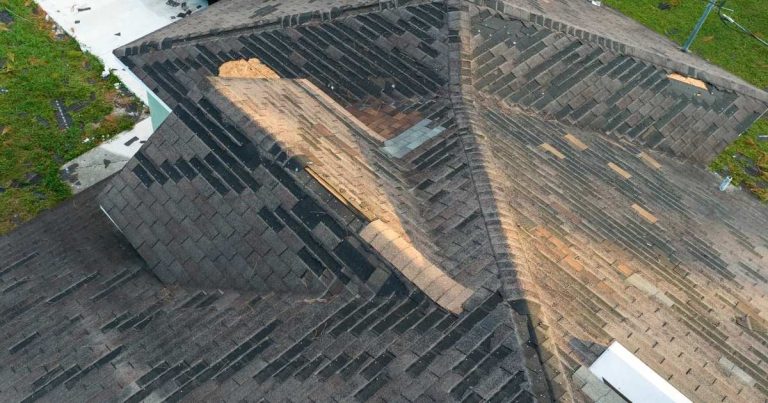
Storm damage roof repair costs in Palm Beach County span a wider range than most homeowners expect — not because contractors price arbitrarily, but because the correct response to storm damage varies dramatically based on damage extent, roof material, age, and what Florida Building Code Section 706 requires. An emergency tarp installation and a full code-compliant tile roof replacement are both legitimate storm damage responses. They cost $800 and $35,000 respectively. Understanding what drives each cost tier — and what Citizens Insurance covers at each tier — is the first step in navigating a storm damage claim without financial exposure.
Emergency tarping: $800 – $1,500
Emergency tarping is the lowest-cost storm response and the one that should happen first in every case of active roof penetration. A licensed CCC contractor installs protective tarping over missing shingles, displaced tile, or any penetration that allows water intrusion — without a permit, without adjuster authorization, and without delay. Citizens Insurance and most private carriers reimburse emergency tarping as a covered expense when it is properly documented with pre-installation photographs and a written contractor assessment.
Cost variables: roof pitch (steeper roofs require more labor and safety equipment), access difficulty, tarp size and coverage area, and emergency response timing. After-hours and weekend emergency calls typically add $150–$300 to base tarping costs. Most Palm Beach County residential emergency tarp installations fall between $900 and $1,200 for a standard-pitched home.
Shingle roof repair: $350 – $2,500
Shingle repair costs depend on the extent of damage, the number of squares affected, and whether the repair requires underlayment replacement beneath the damaged sections. Spot repairs of 1–3 squares — replacing wind-lifted or storm-damaged shingles with matching material — typically run $350–$800 with a permit. Repairs involving flashing, pipe boots, or ridge cap replacement add $150–$400 per component. Repairs approaching the 10–12 square range begin to make full replacement economically competitive, particularly on roofs over 15 years old.
Critical cost factor: FBC Section 706's cumulative 25% threshold. A shingle repair that crosses or approaches the cumulative threshold triggers a mandatory full replacement — changing the cost from $2,500 to $12,000+. A licensed CCC contractor should calculate total historical repair area against the threshold before scoping any repair. For a detailed explanation of how the FBC 25% rule triggers a mandatory full replacement, see our dedicated guide.
Tile roof repair: $500 – $4,500
Tile repair costs vary significantly by tile type (concrete vs. clay), availability of matching tile, and whether the underlayment beneath damaged sections must be replaced. Individual tile replacement runs $35–$75 per tile installed, including underlayment patch and flashing seal where applicable. Larger tile repair events — multiple valleys, significant wind uplift over a contiguous section — can reach $3,500–$4,500 before the FBC Section 706 threshold calculation is triggered.
Tile availability is a meaningful cost driver in post-storm Palm Beach County. Specific concrete and clay tile profiles that were standard in PBC construction between 1990 and 2010 are no longer in production or have long lead times. A repair requiring discontinued tile either involves a profile mismatch (visible and often HOA non-compliant) or a custom tile order with lead times of 6–14 weeks and significant per-unit cost premiums.
Flashing repair: $350 – $2,200
Flashing is the most common source of roof leaks in South Florida and among the most frequently underscoped storm damage items. Step flashing, counter flashing, valley flashing, and chimney cap flashing can all be displaced, compressed, or separated by wind events without visible shingle or tile damage above. Isolated flashing repairs — one valley, one chimney, one pipe boot — run $350–$600. Full perimeter flashing replacement on a standard PBC home runs $1,400–$2,200 including permit and final inspection.
Full roof replacement — FBC Section 706 triggered: $12,000 – $35,000+
When storm damage crosses the 25% threshold, the cost framework changes entirely. The replacement must meet the full requirements of the current Florida Building Code edition — including secondary water barrier, current Product Approval materials, and FBC-compliant fastener schedules for PBC's 160–175 mph design wind speed zone. This is not a cost add-on. It is a code requirement. In active post-storm conditions, expect the ranges below to run 15–35% higher - see emergency roof replacement costs in Palm Beach County for the surge-pricing breakdown.
For licensed storm damage roof repair and FBC-triggered replacement in Palm Beach County, these are the 2026 installed cost ranges by material:
| Material | Installed Cost (per sq ft) | Total Range (2,000 sq ft home) |
|---|---|---|
| Material | Installed Cost (per sq ft) | Total Range (2,000 sq ft home) |
| Architectural Shingle | $9 – $16 | $12,000 – $22,000 |
| Concrete Tile | $18 – $28 | $24,000 – $38,000 |
| Clay Tile | $25 – $45 | $33,000 – $60,000+ |
| Standing Seam Metal | $18 – $32 | $24,000 – $43,000 |
| TPO / Flat Membrane | $8 – $14 | $11,000 – $19,000 |
These ranges include materials, labor, permit fees, secondary water barrier, and final inspection. They do not include tear-off of existing system (add $1.50–$3.00/sq ft), decking replacement if storm damage has compromised the sheathing (add $2.00–$4.00/sq ft), or gutter system replacement (add $1,500–$4,500 for six-inch seamless aluminum on a standard Palm Beach County home).
What Citizens Insurance covers — and what it doesn't
Citizens Insurance covers sudden, accidental damage caused by a covered storm event. It does not cover wear and tear, gradual deterioration, or pre-existing damage that a storm happened to worsen. The practical implication: a roof that was already 22 years old and approaching end of life before the storm will be assessed differently than a 6-year-old roof with storm damage. Citizens' Independent Inspectors evaluate both the storm damage and the pre-storm condition of the roof assembly.
For homeowners with older roofs, the Citizens settlement on a storm damage claim often reflects the roof's depreciated value rather than full replacement cost. Actual Cash Value (ACV) policies pay depreciated value; Replacement Cost Value (RCV) policies pay the full cost of replacement with like materials. Reviewing your policy type before hurricane season — not after the storm — determines whether your claim will cover a full replacement or a portion of it.
The permit cost breakdown by PBC municipality
Permit costs for storm damage repairs vary by municipality. These are 2026 ranges for roofing permits across the primary Tier 1 and Tier 2 cities:
| Municipality | Repair Permit | Replacement Permit |
|---|---|---|
| West Palm Beach | $180 – $320 | $280 – $520 |
| Boca Raton | $200 – $380 | $320 – $580 |
| Palm Beach Gardens | $175 – $310 | $265 – $490 |
| Boynton Beach | $170 – $300 | $260 – $480 |
| Delray Beach | $190 – $340 | $300 – $540 |
| Jupiter | $180 – $320 | $275 – $510 |
| Wellington | $165 – $290 | $255 – $460 |
These fees are paid to the municipality's building department and are separate from contractor costs. They cover the permit application, plan review where applicable, and final inspection by a licensed building official.
Contractor verification and its cost relationship
A CCC license, current insurance, and active permit history are not premium features — they are baseline requirements for any roofing contractor in Palm Beach County. Unlicensed contractors frequently quote 20–40% below licensed contractor pricing. That discount reflects the elimination of insurance premiums, licensing fees, permit costs, and the overhead of operating a code-compliant business. Work performed by an unlicensed contractor carries zero Citizens Insurance eligibility, zero permit protection, and zero recourse if the repair fails.
Verify every contractor at myfloridalicense.com before signing any contract. License status should be Active. Insurance should be current. Any disciplinary action or complaint history is visible in the public record.
For a complete breakdown of what a full roof replacement costs in Palm Beach County by material type, including Citizens Insurance wind mitigation value calculations, see our dedicated 2026 replacement cost guide.
- ✓ Get itemized written quotes from at least two licensed CCC contractors. Line-by-line scope with material specifications, permit inclusion, and final inspection scheduling. Verbal quotes are not sufficient for insurance documentation.
- ✓ Confirm the quote includes permit fees. Permits for storm damage repairs in PBC typically add $170–$580 depending on municipality and scope. If a quote has no permit line item, ask why.
- ✓ Ask your contractor to calculate the FBC Section 706 threshold before finalizing scope. If damage is at or near 25% of total roof area — or cumulative prior repairs bring the total above 25% — the correct scope is full replacement, not repair.
- ✓ Review your Citizens Insurance or private policy for ACV vs. RCV coverage. Actual Cash Value policies depreciate the settlement. Replacement Cost Value policies cover full replacement cost. The difference can be $8,000–$15,000 on an older shingle roof.
- ✓ Do not pay more than 20% upfront. Standard PBC contractor deposit structure is 10–20% at contract signing, balance at completion after final inspection sign-off.
- ✓ Verify contractor license at myfloridalicense.com before signing. Active license status, current insurance, no major disciplinary actions. Takes two minutes and is non-negotiable.
- ✓ Confirm emergency tarping cost is documented separately in the claim. Tarping is a reimbursable emergency expense — it should appear as a distinct line item in your claim submission, not folded into the permanent repair scope.