
Wind mitigation credits are the most significant insurance premium reduction mechanism available to Palm Beach County homeowners — and the most underutilized. A Wind Mitigation Inspection costs $75–$150, takes 45–60 minutes, and generates documented construction feature data that Citizens Insurance and most private carriers translate directly into annual premium reductions. For a PBC home with fully favorable construction features — hip roof, secondary water barrier, compliant roof covering, nailed decking, and protected openings — the annual premium reduction can exceed the inspection cost within the first month of the updated policy. Understanding exactly which construction features generate credits, how much each credit is worth, and what can be done to improve a home's wind mitigation profile is the practical knowledge that turns a routine inspection into a meaningful financial planning tool.
How wind mitigation credits work — the OIR-B1-1802 form
Wind mitigation credits are calculated based on the construction features documented on Florida's OIR-B1-1802 Uniform Mitigation Verification Inspection Form — the standardized form used by all Florida insurers for wind mitigation credit calculation. A licensed wind mitigation inspector visits the property, documents the construction features in each of the form's credit categories, and submits the completed form to the insurer. The insurer applies their actuarial credit model to the documented features and reduces the annual premium accordingly.
The OIR-B1-1802 evaluates six construction feature categories: roof shape, roof deck attachment, roof-to-wall connection, roof covering, opening protection, and secondary water barrier. Each category has multiple options that generate different credit levels — from no credit (least favorable construction) to maximum credit (most favorable). The total premium reduction is the sum of credits across all categories, applied to the wind portion of the premium which is typically 60–80% of the total premium on coastal PBC policies.
Wind mitigation reports are valid for 5 years. After 5 years, re-inspection is required to continue generating credits. After any roof replacement that changes the construction features (adding secondary water barrier, upgrading roof covering to a compliant product), a new Wind Mitigation Inspection should be ordered immediately — the updated features may generate significantly higher credits than the pre-replacement report.
Roof shape — the single largest credit category
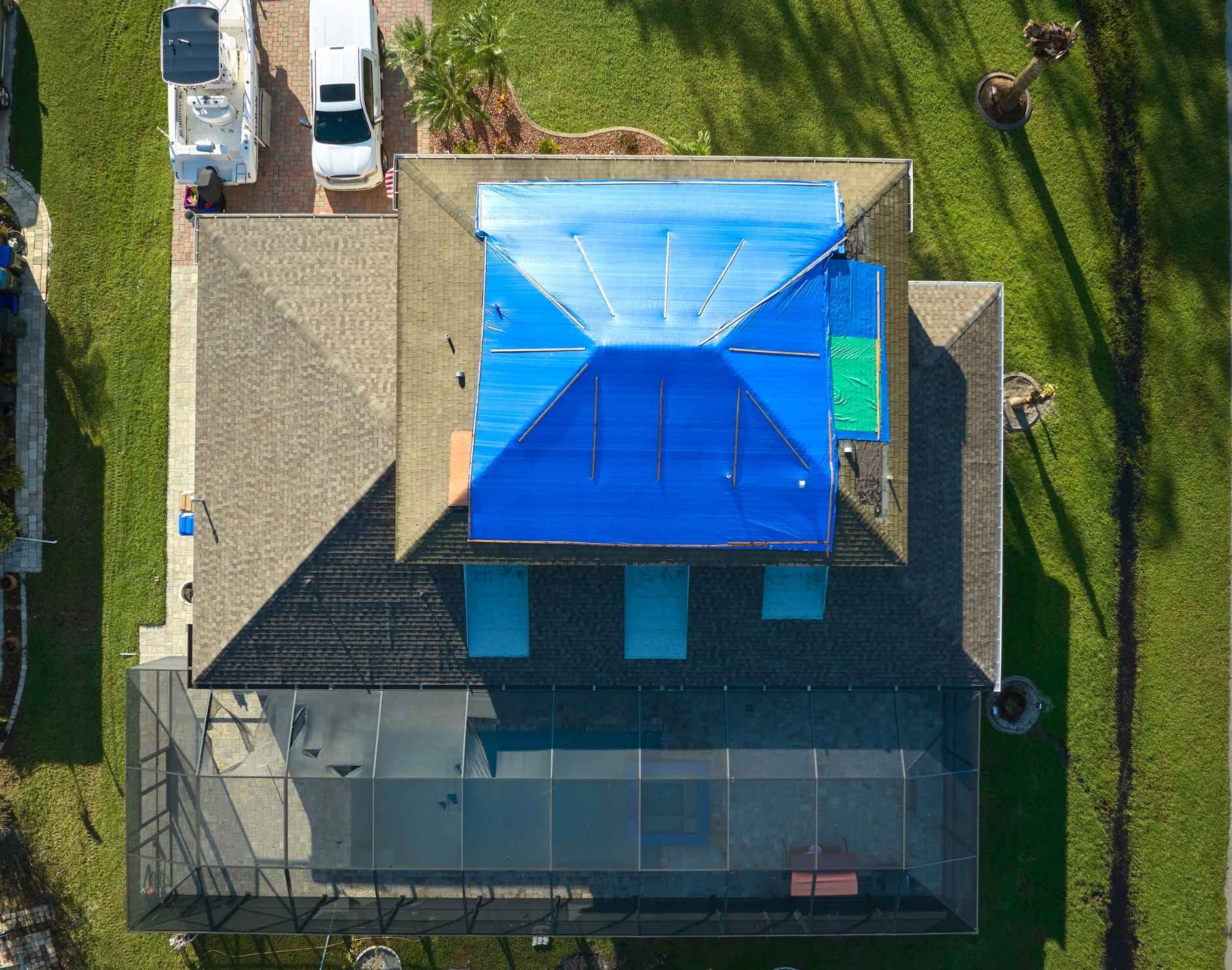
Roof shape is the highest-value credit category on OIR-B1-1802 and the one construction feature that cannot be modified by a roofing contractor. Hip roofs — roofs where all four faces slope toward the peak — generate the maximum roof shape credit because hip geometry reduces wind uplift forces at the roof perimeter relative to gable roofs. Gable roofs — roofs with two sloped faces and two vertical end walls — generate no roof shape credit because the gable end walls are highly vulnerable to wind pressure.
In coastal PBC zip codes, the difference in annual premium between a hip roof and a gable roof under Citizens Insurance is typically $400–$1,200 per year — a fixed credit based entirely on the architectural design of the home. For PBC homeowners with hip roofs, this credit is already embedded in their premium calculation. For homeowners with gable roofs considering a major renovation, converting gable ends to hip configuration generates a permanent annual premium credit that partially offsets the renovation cost.
Roof deck attachment — the inspection's most variable finding
Roof deck attachment documents how the plywood or OSB decking is fastened to the roof framing — specifically the nail type, nail length, and nail spacing used throughout the deck. The credit options range from staples or 6d nails at wide spacing (no credit or minimal credit) to 8d ring-shank nails at 6-inch spacing (maximum credit).
The deck attachment credit is the finding that most surprises PBC homeowners — the difference between minimum and maximum deck attachment credit can be $300–$700 per year in premium, and the actual fastening pattern under the existing roof surface is not visible without removing roofing or probing the deck from below. Inspectors verify deck attachment by probing the deck surface through the attic or by lifting representative roofing at the eave — the specific nail type and spacing pattern determine which credit category applies.
On any roof replacement, the opportunity to upgrade deck attachment to 8d ring-shank nails at 6-inch spacing throughout is available at modest incremental cost — typically $0.50–$1.50 per square foot — and generates a permanent deck attachment credit that persists for the life of the new roof. For roof inspection services in Palm Beach County including Wind Mitigation Inspections that document all credit categories and maximize the annual premium reduction available to your property, a licensed inspector provides the complete OIR-B1-1802 assessment and submits the report in the format required by Citizens and private carriers.
Secondary water barrier — the roofing credit
Secondary water barrier credit on OIR-B1-1802 is one of the most straightforward — the property either has a self-adhering modified bitumen secondary barrier bonded directly to the roof deck, or it does not. The credit for having a secondary water barrier is a specific reduction in the wind coverage portion of the premium — typically $150–$400 per year in coastal PBC zip codes. Homes built before the HVHZ secondary water barrier requirement became standard, or homes that have had unpermitted roof replacements that omitted the secondary barrier, do not have this feature and do not receive the credit.
The secondary water barrier credit is obtained permanently when a compliant roof replacement includes the barrier — it is not a recurring inspection item, it is a documented construction feature that persists for the life of the roof assembly. On any PBC roof replacement, the secondary water barrier is both a code requirement and an insurance value driver. Omitting it is simultaneously non-compliant and insurance-value-destroying. Licensed roofers in Wellington and across PBC include it as baseline scope.
Roof covering — the product approval credit
Roof covering credit documents whether the installed roofing system carries a current Florida Product Approval for the applicable HVHZ design conditions. A roof with a compliant Product Approval generates credit; a roof with non-compliant or unverified products does not. The credit amount varies by product type and design conditions but typically generates $100–$300 per year in coastal PBC zip codes for compliant installations. The roof covering credit is another reason that HVHZ product compliance — beyond its code requirement status — has direct and ongoing financial value through annual premium savings.
Opening protection — the highest-value single upgrade
Opening protection documents whether the home's windows, doors, and garage doors are protected against wind-borne debris — either through impact-resistant glazing (impact windows and doors) or through rated storm shutters. Opening protection generates the highest single-category credit on OIR-B1-1802 — in coastal PBC zip codes, maximum opening protection credit can reduce annual Citizens premiums by $1,200–$3,500 per year depending on the home's location, size, and base premium.
The opening protection credit interacts with the roof shape credit — homes with both favorable roof shape (hip) and maximum opening protection generate the two largest individual credits on OIR-B1-1802, and their combined effect represents the majority of the total wind mitigation premium reduction available to most PBC homes. For homeowners without current opening protection considering an upgrade, the annual credit payback period for impact window installation in coastal PBC zip codes is typically 8–15 years — making the upgrade financially justifiable for homeowners planning long-term occupancy.
What a complete wind mitigation credit picture looks like for a PBC home
A PBC home with fully favorable construction features — hip roof, 8d ring-shank nails at 6-inch spacing deck attachment, secondary water barrier, compliant roof covering, roof-to-wall straps, and impact windows and doors — can generate annual Citizens Insurance credits of $1,500–$3,500 in coastal zip codes. A home with some favorable features — hip roof and secondary water barrier but no opening protection — generates $600–$1,200 per year. A home with only the roof shape credit and no other favorable features generates $400–$600 per year.
For a complete explanation of what the Wind Mitigation Inspection covers — how inspectors assess each credit category, what documentation they review, and how to prepare your PBC home for the best possible inspection outcome — see our dedicated wind mitigation guide.
- Order a Wind Mitigation Inspection within 30 days of permit close on any new roof installation.** Credits apply from the date the insurer processes the report — not from the installation date. Every month of delay is forfeited credit.
- If you have never filed a Wind Mitigation Inspection, order one now.** Many PBC homeowners with favorable construction features — hip roofs, impact windows, newer roofs — have never filed and are overpaying their premiums annually. The inspection costs $75–$150 and typically recovers its cost within the first month of the updated policy.
- On any roof replacement, upgrade deck attachment to 8d ring-shank nails at 6-inch spacing.** The incremental cost is $0.50–$1.50 per square foot; the annual premium credit is $300–$700 per year. The upgrade pays back within the first 1–3 years.
- Confirm secondary water barrier is included in any PBC roof replacement.** The secondary barrier is both a code requirement and an annual insurance credit generator. Its omission costs compliance and forfeits a permanent annual credit.
- Renew your Wind Mitigation report every 5 years.** Reports expire after 5 years — a lapsed report means lost credits until a new inspection is filed.
- For coastal PBC properties without opening protection, evaluate impact window installation ROI.** Annual opening protection credits of $1,200–$3,500 produce payback periods of 8–15 years — financially justifiable for long-term homeowners.
- Submit the Wind Mitigation report to your insurer promptly after filing.** Credits do not apply automatically — the insurer must process the report and update the policy. Follow up with your agent to confirm the credit has been applied.


