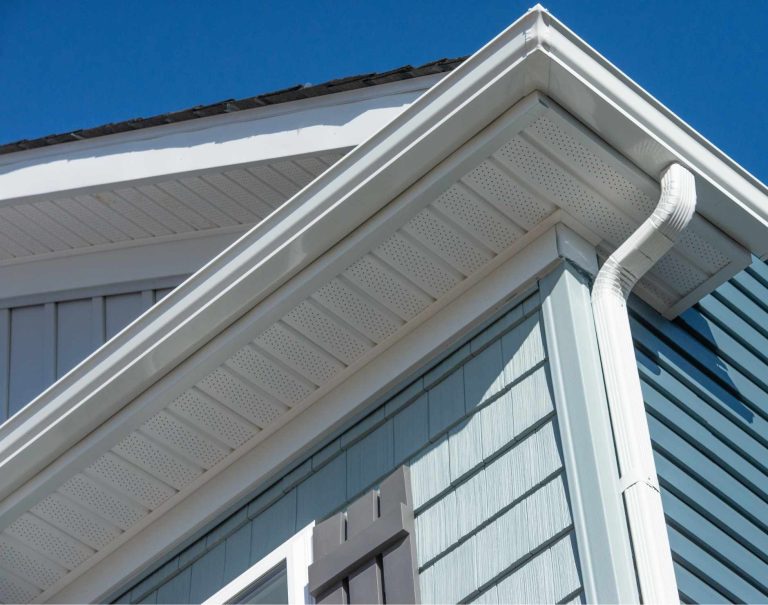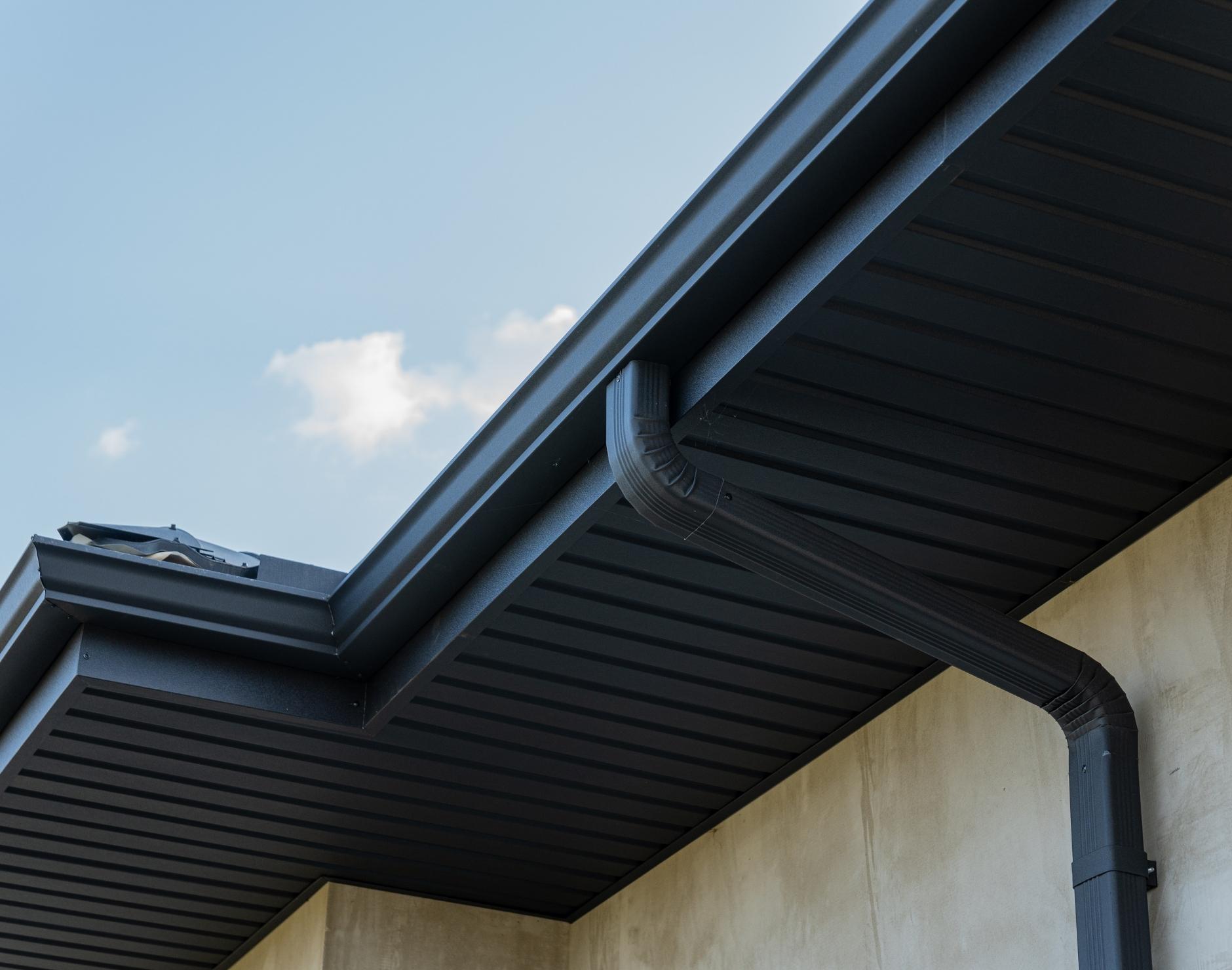
The seamless vs. sectional gutter comparison resolves quickly in Palm Beach County — and not in the direction that budget-focused contractors prefer. Sectional gutters are pre-cut aluminum panels joined at overlapping seams every 10–12 feet along the gutter run. Each joint is a potential leak point sealed with caulk or gutter sealant. In South Florida's environment — where rainfall intensity during wet-season thunderstorms overwhelms the flow capacity of undersized gutter systems, where daily thermal cycling expands and contracts every metal component, and where coastal salt air corrodes exposed metal faster than in any other major Florida market — sectional gutter joints fail progressively throughout the system's service life. Seamless gutters eliminate those joints entirely. For PBC residential and commercial properties, seamless is the only specification worth considering.
What sectional gutters are and why they underperform in PBC
Sectional gutters are formed from pre-cut aluminum coil stock in standard 10-foot or 12-foot lengths that are joined end-to-end with overlapping seam connectors and sealed with gutter sealant. They are sold at home improvement stores and can be installed without specialized equipment. In temperate climates with moderate rainfall, well-maintained sectional gutters perform adequately for 10–15 years before joint sealant failure produces systematic leaking.
In Palm Beach County, the three failure mechanisms that limit sectional gutter performance are accelerated relative to temperate conditions. Thermal cycling failure: PBC's daily temperature swing between overnight lows and afternoon highs — combined with the sudden temperature change when cold wet-season rain hits aluminum heated to 120°F by direct sun — produces rapid expansion-contraction cycles that stress the caulked joint seal far more aggressively than temperate climate cycling. Sealant failure at joints typically begins within 3–5 years on south-facing and west-facing exposures in PBC.
Rainfall overflow failure: PBC's wet-season thunderstorms produce rainfall intensities of 3–5 inches per hour for short durations — far exceeding the capacity of standard sectional 5-inch K-style gutters on any roof with significant tributary area. When the gutter overflows, the overflow concentrates at joint locations where the sealant has already begun to separate, producing both exterior overflow and joint leakage simultaneously. The result is fascia saturation and eventually soffit damage from water that entered behind the failed joint rather than over the gutter edge. When to repair versus replace an aging system is covered in gutter repair vs. replacement for PBC.
Coastal corrosion: the salt-air environment present throughout PBC's coastal zone — barrier islands, oceanfront, Intracoastal-adjacent properties — corrodes exposed aluminum gutter joint hardware, screws, and sealant interfaces faster than inland conditions. Joint hardware that would last 15 years inland may show corrosion-driven sealant separation within 5–7 years on a coastal PBC property.
What seamless gutters are and why they perform correctly in PBC
Seamless gutters are formed on-site from continuous aluminum coil stock using a portable roll-forming machine that produces a single continuous gutter run from the start of one downspout to the next — with no intermediate joints. The only joints in a seamless gutter system are at inside corners, outside corners, end caps, and downspout outlets — all of which are fabricated and sealed once at installation and do not experience the thermal cycling fatigue that mid-run sectional joints develop.
The elimination of mid-run joints is seamless gutters' defining performance advantage in PBC's environment. With no joints to fail between downspout locations, the primary water infiltration path that causes fascia and soffit damage in sectional systems does not exist. The seamless system's continuous aluminum profile also handles the flow concentration that occurs during PBC's high-intensity rainfall events better than sectional systems — the continuous profile does not have the flow interruptions at joint locations that cause turbulence and overflow concentration in sectional runs.
Six-inch K-style seamless aluminum gutters — the correct specification for most PBC residential applications — are formed from the same aluminum coil stock as standard 5-inch gutters but provide 40% greater cross-sectional flow capacity. On PBC roofs where 5-inch gutters overflow during standard wet-season thunderstorms, 6-inch seamless gutters resolve the overflow condition without requiring additional downspouts. For gutter installation services in Palm Beach County, every installation uses 6-inch seamless aluminum formed on-site — the specification appropriate for PBC's rainfall intensity and thermal cycling environment.
Material options beyond aluminum — steel, copper, and vinyl
Standard seamless gutters in PBC are formed from 0.032-inch or 0.027-inch aluminum coil stock — the industry standard that balances cost, durability, and formability. Two alternative materials are used for specific PBC applications.
Copper gutters are specified for high-end residential properties in Palm Beach, Manalapan, Boca Raton, and Jupiter Inlet Colony where architectural character and material longevity justify the cost premium. Copper patinas naturally in South Florida's climate, developing a green-gray surface that is both visually distinctive and highly corrosion-resistant. Copper gutter systems last 50–100 years with minimal maintenance — a material that will outlast the building's roofing system several times over. Verified roofers serving Manalapan and PBC's estate communities install copper systems routinely. Installed cost for copper gutters in PBC runs $25–$45 per linear foot versus $8–$15 per linear foot for standard aluminum seamless systems.
Vinyl sectional gutters should not be specified for PBC applications. Vinyl becomes brittle under prolonged UV exposure and loses dimensional stability under PBC's thermal cycling — sectional vinyl joints fail faster in South Florida than aluminum sectional joints, and the material cannot be formed seamlessly. Vinyl gutters are not appropriate for any PBC residential or commercial application where service life beyond 5–7 years is expected.
Installation quality variables — what separates a correct PBC gutter installation
Beyond the seamless vs. sectional specification, several installation variables determine whether a gutter system performs correctly through PBC's wet seasons. Hanger spacing is the first — gutter hangers should be spaced at 18–24 inches maximum on PBC installations, not the 36-inch spacing common in temperate climate installations. South Florida's rainfall intensity and the weight of water in a flowing gutter during a thunderstorm impose greater load on hangers than moderate rainfall, and the thermal cycling that expands and contracts the gutter system stresses hanger attachment points continuously. Inadequate hanger spacing produces gutter sag that disrupts the designed slope toward downspouts, creating low points where water pools and debris accumulates.
Slope to downspouts is the second variable. Gutters must slope toward downspouts at a minimum of 1/16 inch per foot — a slope that is set at installation and can only be corrected by re-hanging the gutter. A level gutter — installed without slope — pools water at low points during the intervals between storms, promoting algae and debris accumulation that accelerates corrosion and eventually clogs the downspout outlet.
Downspout sizing and discharge location are the third variable. Standard 2×3 inch rectangular downspouts are undersized for 6-inch gutters on PBC roofs with significant tributary areas. Three-inch round or 3×4 inch rectangular downspouts provide the flow capacity needed to drain 6-inch gutters rapidly during high-intensity PBC rainfall. Downspout discharge must direct water at least 3–4 feet from the foundation — a requirement that is frequently violated by the use of standard 6-inch splash blocks that discharge adjacent to the foundation in high-flow events.
For a complete explanation of how gutter sizing is calculated for PBC's specific rainfall intensity — including the tributary area calculation and the downspout sizing that supports it — see our dedicated gutter sizing guide.
- Specify 6-inch K-style seamless aluminum — not 5-inch, not sectional.** Six-inch seamless is the minimum appropriate specification for most PBC residential applications. Sectional gutters of any size are not appropriate for South Florida's rainfall intensity and thermal cycling environment.
- Confirm 0.032-inch aluminum gauge — not 0.027-inch.** Heavier gauge aluminum provides better resistance to physical damage from falling debris during hurricane season and better resistance to thermal cycling fatigue at hanger attachment points.
- Verify hanger spacing of 18–24 inches maximum.** Standard 36-inch spacing is inadequate for PBC's rainfall loads and thermal cycling. Specify the hanger spacing as a written scope item.
- Confirm slope toward downspouts of 1/16 inch per foot minimum.** Ask the installer how they verify slope at installation — string line or laser level. A gutter installed without verified slope will pool water at low points.
- Specify 3-inch round or 3×4 inch rectangular downspouts.** Standard 2×3 inch downspouts are undersized for 6-inch gutters on PBC roofs with significant tributary areas during high-intensity rainfall events.
- Confirm downspout discharge directs water 3–4 feet minimum from the foundation.** Splash blocks adjacent to the foundation are not adequate discharge for PBC's rainfall volumes. Extensions or underground discharge lines may be required.
- For coastal PBC properties, confirm gutter hardware is stainless steel or aluminum — not galvanized.** Galvanized screws and hangers corrode rapidly in salt-air environments and produce rust staining on light-colored exterior walls.